Hunting the Friendship Theme: Three Methods, One Album
music
nlp
python
embeddings
The LLM labelers found friendship in only 2 of 107 Carly Rae Jepsen songs. A fan knew better — and topic models, embedding probes, and a keyword audit back the fan.
NoteA note on how this was made
- Built by directing an AI research assistant.
- I set the hypothesis, the chorus-control requirement, and the demand for placebo baselines. Claude wrote and ran the models.
- I approved the probe texts and sent results back for rework.
- The previous post had two Claude models tag every Carly Rae Jepsen song against a 13-theme vocabulary, keeping only tags both agreed on.
- It worked: the models agreed, and most themes landed where a listener would put them.
- Friendship — the theme that got me interested in the first place — survived consensus in only 2 of 107 songs.
- The word “friend” alone appears in 19 songs. Boundary songs (The One, Fever, Body Language) got zero tags.
- This post re-attacks the catalog with methods that don’t share the labelers’ assumptions: topic models, then embedding probes.
The corpus
- 113 catalog songs (Kiss onward), 107 unique after remix dedup.
- Repeated lines removed within each song (~46% of all lines), so a chorus sung five times doesn’t get five times the weight.
Method 1: topic models
- Both models run at k=8 on the chorus-deduplicated text.
- Each has its own way to keep shared pop vocabulary (love, know, baby, heart) from swamping every topic:
- LDA on word counts, with document-frequency pruning — words in more than a quarter of songs are dropped.1
- NMF on TF-IDF, where IDF weighting does the same job softly.
- Topics paired by matching each LDA topic to its nearest NMF topic; labels drawn from both word lists.
| Label | LDA topic (top words) | NMF topic (top words) |
|---|---|---|
| Wanting a friend | friend, real, feels, thinking, getting, things, good, alright, end, used, change, life | want, way, need, lost, cut, friend, real, just, feeling, hold, think, fall |
| Run away together | away, come, run, stay, body, little, thinkin, hands, open, head, close, hold | away, run, stay, thinkin, body, stuck, hands, baby, party, sleepin, touch, bout |
| Really liking a boy | touch, really, boy, sound, try, tell, mind, afraid, look, words, room, getting | like, say, really, know, feel, got, boy, just, did, tell, close, touch |
| Deciding on the beat | come, tell, making, lost, believe, good, day, thinking, boy, heartbeat, pick, speeding | thinking, come, making, know, sure, beat, dance, believe, heart, knees, regrets, bout |
| Big crazy love | hold, gimme, cut, warm, boy, falling, stand, bad, crazy, really, hard, hurt | love, know, baby, crazy, open, feel, girl, little, gimme, hold, heart, head |
| Turning it around tonight | turn, good, kiss, wish, talk, higher, somebody, high, alright, real, did, breaking | turn, alright, new, tonight, hold, play, wrong, tight, just, melt, outside, comes |
| Goodbyes & moving on | goodbye, body, scared, lost, kiss, city, heartbeat, devotion, feels, come, care, words | time, good, goodbye, try, like, matter, night, free, needed, mind, talk, live |
| The leftovers (no clean pair) | believe, girl, rest, open, said, told, door, sleep, turn, calling, wrong, hold | afraid, getting, right, feels, baby, close, happy, life, kinda, real, hypnotized, words |
- Both models produce a friend topic unprompted. Songs loading on LDA’s version: Your Type, Body Language, Real Love, Let’s Be Friends, After Last Night, Weekend Love.
- The friend pair only overlaps on two words — friend and real. LDA’s topic is about friendship; NMF’s is about wanting, with friend inside it.
- First sign of why a codebook defining friendship as “platonic bonds, companionship outside romance” missed it: friendship vocabulary co-occurs with wanting vocabulary in this catalog.
Method 2: embedding probes, with placebos
- Partly a hedge against the topic models not working. They worked — but probes can do something topic models can’t: ask directly about a theme instead of waiting for it to emerge.
- Songs split into sections (chorus kept once): 760 chunks, embedded with a local MiniLM encoder.
- Short probe texts describing each theme embedded in the same space; chunks ranked by cosine similarity.
- Three friendship probes, because “friendship” isn’t one thing:
- platonic — friendship as its own kind of love, loyalty that isn’t romantic
- friend-lover boundary — falling for a friend, insisting “we’re just friends” when it’s clearly more
- refuge — friends as comfort when romance fails, dancing with friends instead of a lover
- Plus the 13 original codes and three placebo probes (war, religion, money) as the noise floor.
- Every score z-scored within its own probe — raw cosines aren’t comparable across probes.
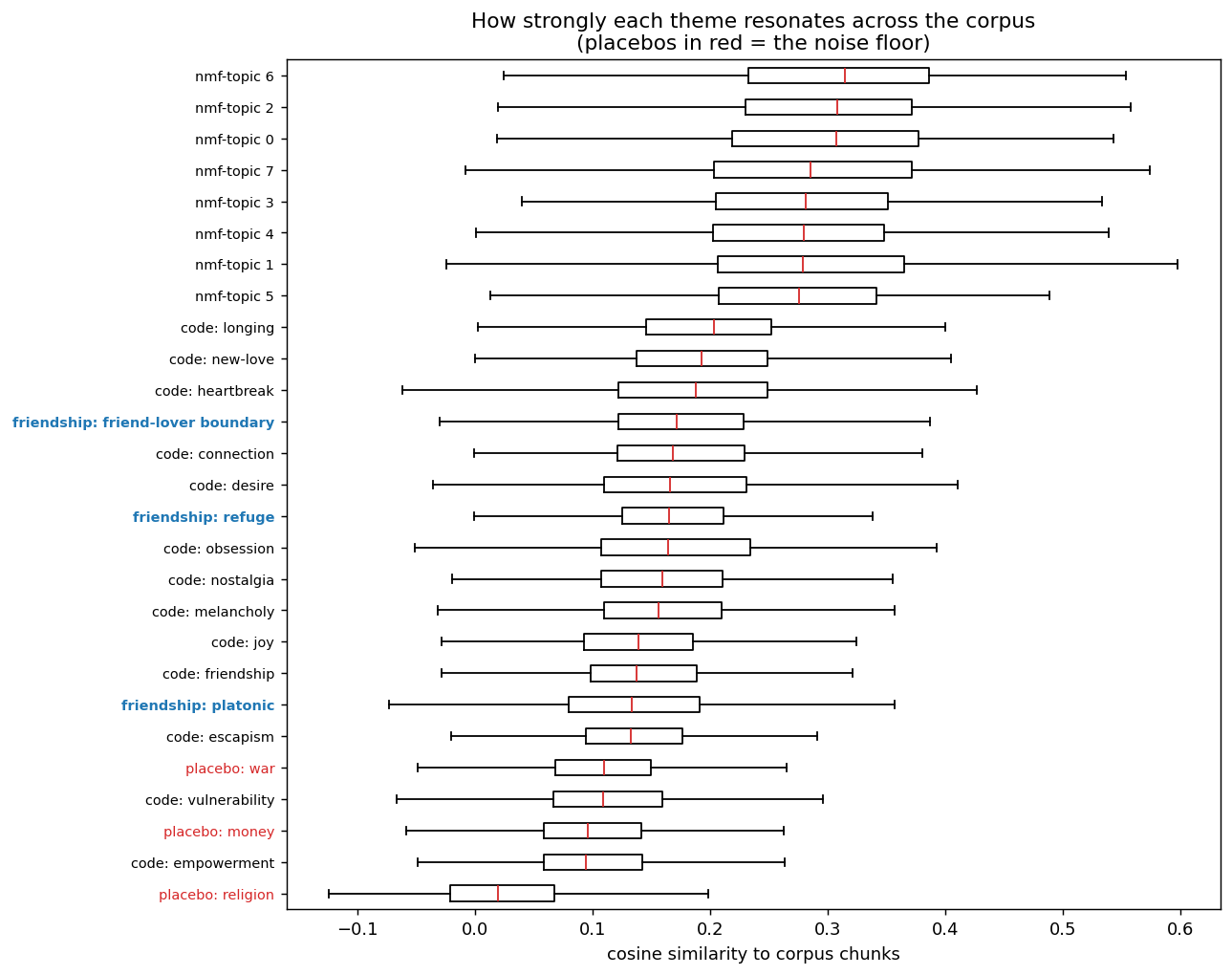
What the friendship probes found
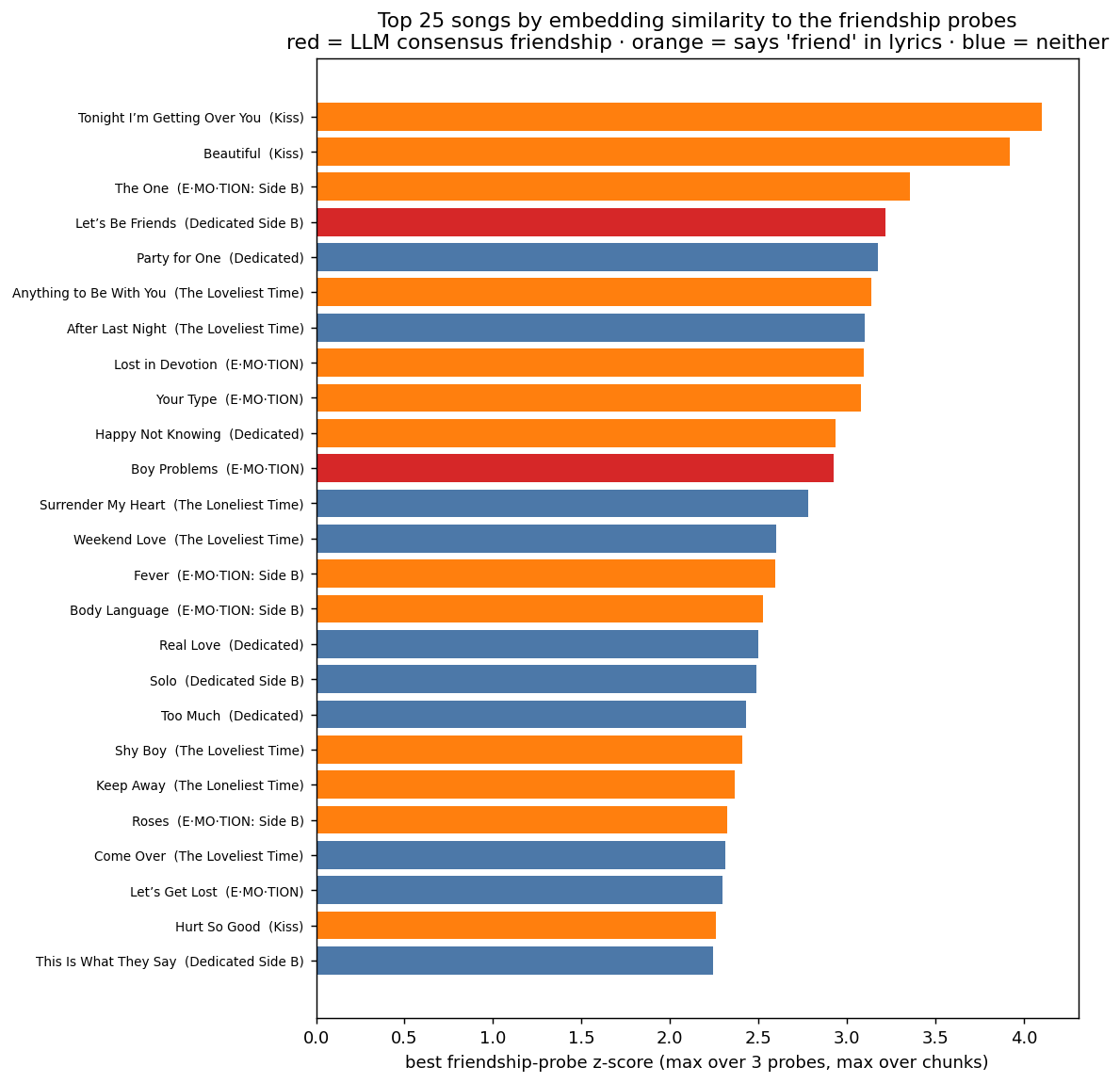
- Both LLM-consensus songs are recovered: Let’s Be Friends (#4), Boy Problems (#11).
- Keyword songs the labelers skipped rank at the top: Tonight I’m Getting Over You (“we’re not lovers, but more than friends”), Beautiful (“just friends, the beginning or the end”), The One, Your Type — the contested-boundary songs.
- New candidates (no “friend” keyword, no LLM tag): Party for One (friendship 3.17 vs best placebo 1.27), Surrender My Heart (2.78 vs 2.58), After Last Night (3.10 vs 3.17). All three score via the refuge probe.
- Of the three probe variants, refuge edges the others — best-scoring for 38 of 107 songs and driving 10 of the top 25 — though the three are close (friend-lover boundary 36 and 9, platonic 33 and 6).
How friendship is discussed: mostly, it hurts
- Two contrast probes (friendship-as-joy vs. friendship-as-pain), scored on each song’s most friendship-like section.
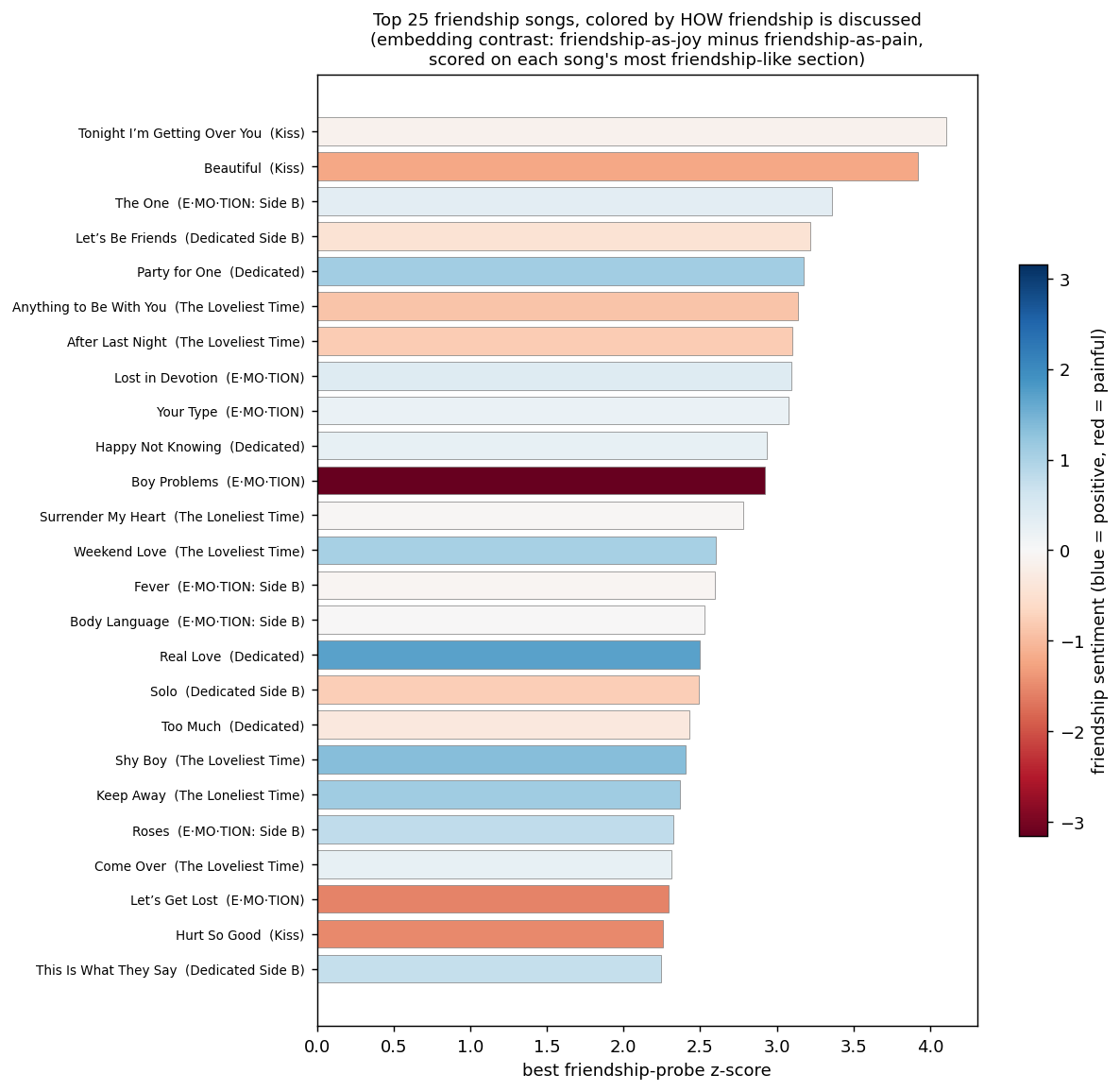
- Friendship writing leans painful.
- Boy Problems is the extreme (−3.15 — “what’s worse, losing a lover or losing your best friend?”).
- Most of the top ten sit on the red (painful) side.
- Warm friendship songs — Party for One (+1.09), Real Love, Shy Boy, Weekend Love — rank lower, skew late-catalog.
| Song | Album | Friendship z | Best placebo z | Sentiment |
|---|---|---|---|---|
| Tonight I’m Getting Over You | Kiss | 4.10 | 1.54 | −0.14 |
| Beautiful | Kiss | 3.92 | 1.15 | −1.22 |
| The One | E·MO·TION: Side B | 3.36 | 2.91 | +0.34 |
| Let’s Be Friends | Dedicated Side B | 3.22 | 2.48 | −0.46 |
| Party for One | Dedicated | 3.17 | 1.27 | +1.09 |
| Anything to Be With You | The Loveliest Time | 3.14 | 3.55 | −0.90 |
| After Last Night | The Loveliest Time | 3.10 | 3.17 | −0.81 |
| Lost in Devotion | E·MO·TION | 3.10 | 2.14 | +0.40 |
| Your Type | E·MO·TION | 3.08 | 0.94 | +0.21 |
| Happy Not Knowing | Dedicated | 2.94 | 3.99 | +0.26 |
| Boy Problems | E·MO·TION | 2.92 | 1.63 | −3.15 |
| Surrender My Heart | The Loneliest Time | 2.78 | 2.58 | −0.03 |
- Six of the top 25 — Real Love, Happy Not Knowing, Keep Away, Anything to Be With You, Weekend Love and After Last Night — score higher on a placebo probe than on any friendship probe. Bold placebo values above mark those cases.
- Scores are z-scored within each probe, so this compares how unusual a song is for each probe, not raw similarity.
Theme by album
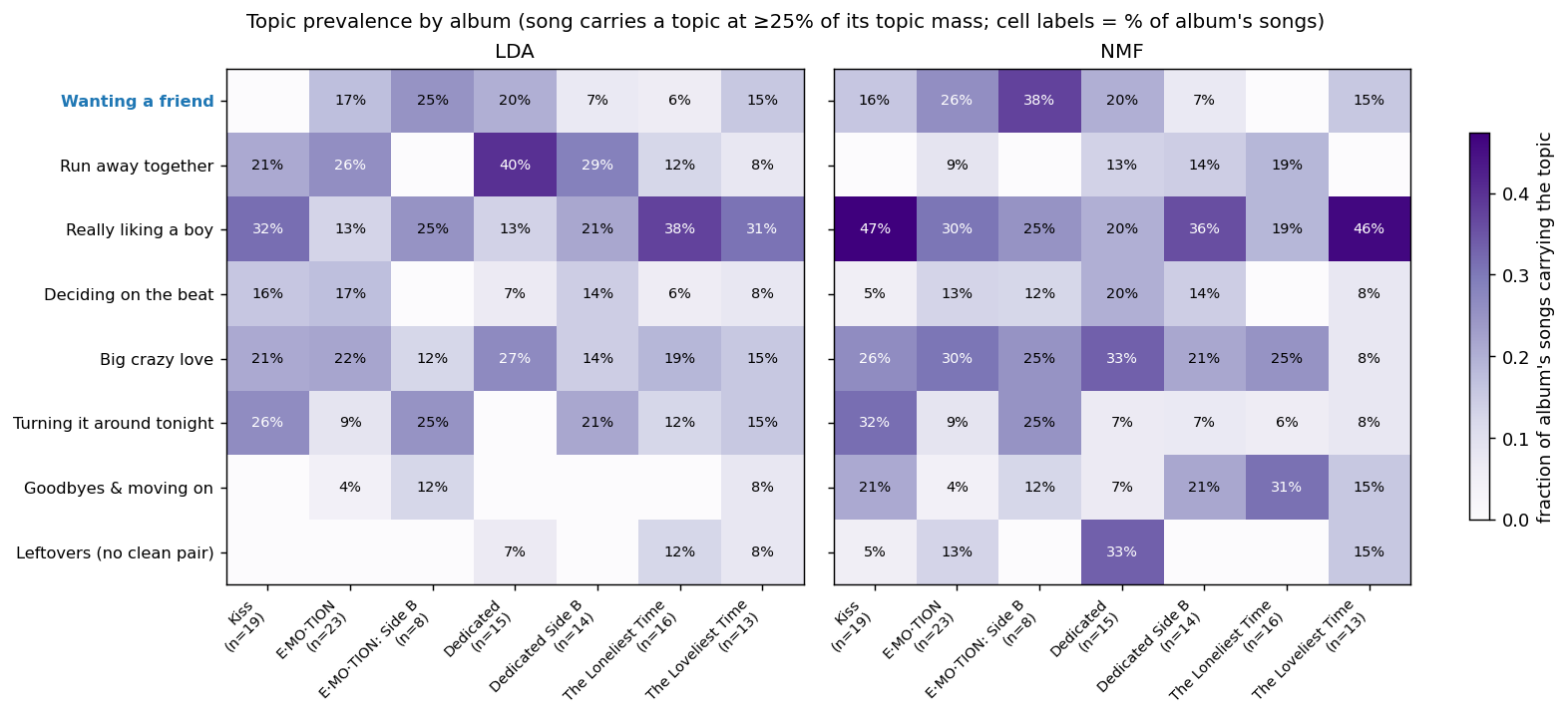
- The 8 unified themes from Method 1 (paired LDA/NMF topics), tracked by album instead of pooled across the catalog.
- Cell = fraction of an album’s songs carrying that topic (≥25% of the song’s topic mass); numbers = song counts.
What I make of it
- The labelers found friendship in 2 songs. The word “friend” appears in 19, and both topic models produced a friend topic without being asked for one.
- The probes recover both labeled songs and rank the keyword songs the labelers skipped at the top — Tonight I’m Getting Over You and Beautiful have the widest margins over their placebos in the whole set.
- Where the probes go beyond the keyword, the evidence thins. Of the three songs with neither a keyword nor a label, one has a clear margin (Party for One), one is narrow (Surrender My Heart), and one is beaten by a placebo (After Last Night).
- The codebook was the constraint, not the models. Defining friendship as “platonic bonds, companionship outside romance” excludes the boundary songs, which is where this catalog actually puts it.
Next: an updated theme map in the style of the previous post — built on the NMF topics and their LLM-generated labels, so the vocabulary comes out of the songs themselves instead of a hand-written codebook.
Footnotes
Pruning must be by document frequency, not TF-IDF weight: ubiquitous words like love carry high TF-IDF here simply from repetition, so a TF-IDF cutoff wouldn’t remove them.↩︎